

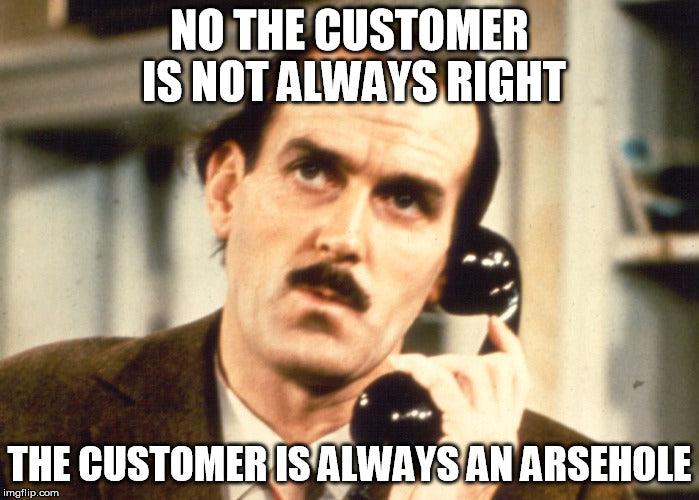
So here we are, having run this vague little webshop since last autumn (autumn 2017). Financially this produces absolutely nothing, but spiritually, running our own little shop is a pretty fun hobby.
Customer service is generally really nice work, answering messages and dealing with returns or warranty replacements. The only downside, really, is having to deal with customers. Luckily it’s an online shop, so we never actually have to meet anyone.
Even though we’ve had this shop up and running for less than a year, we’ve gradually managed, with the wisdom provided by three university courses, to identify different types of online shop customers. Since a quick Google suggests nobody else has managed to study this properly, we decided to write a bit about the types we’ve run into.
- The non-buyer complainer
The non-buyer complainer is the kind of person who isn’t even ordering anything, but still feels it’s their duty to tell you that the product you’re selling is crap or that they can get it cheaper somewhere else. These only operate on the internet. In the real world, the same people probably wouldn’t march into the entrance of Prisma and start yelling that your vegetables are shit and that same Nikkei knife set is cheaper on TV Shop.
The motivation of the non-buyer complainer remains one of humanity’s great mysteries. Our customer service policy is to advise these people to order that better product from somewhere else.
- The email rabbit
The order has been placed. The order confirmation didn’t arrive immediately. I’ll email the seller. Now it arrived. I’ll send another email saying the confirmation came through. Oh right, I forgot to ask if batteries are included. I’ll send an email about that too. The seller didn’t reply within an hour. I’ll ask again. While I’m at it, I’ll also ask whether the package is going to the post office or to that K-Market locker.
The email rabbit has an awful lot to say, and messages come in faster than anyone can react to them. We still try to answer every question, even though in the long run it starts to piss us off.
- Stupid. And mean.
Some people are just plain fucking stupid. There’s no getting around that, no matter how much goodwill you bring to it. Even if a device only has one button, pressing it is still beyond some people. Stupidity also usually goes hand in hand with definitely not reading the instructions. Somehow the dumbest people also always have the most fragile egos, so the fault is always everyone else’s. The product is shit, you don’t know how to advise people, and “I definitely did everything right”.
We politely take the abuse, patiently give advice, and ask them to return the shitty product. Mysteriously, the returns sent in by these stupid people always work just fine when we test them ourselves.
- Wanting value for money
Some people simply cannot wrap their heads around the fact that a twenty-euro Chinese gadget, which does its job quite nicely to be fair, isn’t actually quite as fancy and good as a product that costs ten times more. The disappointment is probably similar to what my spouse feels in bed, but while the spouse merely turns over and dreams of real men, the customer decides to complain about absolutely everything they can think of. Almost without exception, though, the complaint still ends with the product not being returned, because the customer knows perfectly well it’s the best thing you can get for that money. They just had to complain.
From a customer service perspective, these people aren’t bad. We’re used to disappointing others. Our own father, for example. Since childhood. We know how to handle it.
- The expert
Everyone has at least one annoyingly fucking irritating friend like this who thinks they know everything and, even when they’re wrong, absolutely refuse to admit it. These people usually have no business other than demonstrating their own superiority by explaining how some device that costs €1000 more is so much better than your product. They also usually have a better understanding of how online retail or marketing ought to be handled.
These people are usually failures in life. We feel sympathy for them and try to pretend we care.
- The offended one
This isn’t really an actual customer group, but whenever we send out a newsletter, some fatso immediately starts whining that you can’t say things like that. Then, as revenge, they unsubscribe from the newsletter because the subject line had the word fuck in it. These offended people are everywhere now, and we have a fully deliberate strategy of trying to weed them out of our customer base.
The best thing about being an entrepreneur is that, if we want to, we can tell someone to go climb a tree. These days everyone gives in to these people, so the reaction is almost tangible when the complainer’s crying gets ignored.
- The ghost
As a bachelor, we got used to women mysteriously disappearing after a couple of messages or, at the latest, after the first date. As shopkeepers we’ve run into a somewhat similar phenomenon a couple of times. First they ask loads of questions or send a message about something perfectly legitimate, like a warranty return. Then when we try to respond, the person has vanished like a fart into the Sahara.
There’s not really anything we can do about these people, but it is a bit confusing when first there’s some urgent matter that needs sorting out, and then once we start sorting it out, the person disappears completely.
- The freeloading friend
You’d think that if your friend has a shop or some other business, shopping there would support your friend’s business. But that’s not how it goes. From a friend’s business, you obviously beg for free samples and steep discounts. Then, because we’re so nice, we of course always hand out discounts generously to friends, and at the end of the month we wonder why we can’t afford great-grandma’s cancer meds and the debt collectors are taking the kids.
This isn’t a huge problem for us, since we don’t have any friends. Also, this shop isn’t really our actual livelihood. I live on city support and my buddy is a pensioner.
- The worst of all
There is one customer segment where all of the above traits very often come together. Namely a certain type of female customer. In English there’s a term for this type of person: Karen. There isn’t really a proper Finnish term for it, so we’ll just use the English one.
Karen asks questions and complains in advance, sends a million emails after ordering the product, can’t figure out how to use it, complains, returns it, gets disappointed and offended. After that Karen wants to complain to the CEO.
Luckily, not all women are this kind of female customer. Some women are completely normal customers. There are also trans customers who are men, until they start turning into an online shop Karen.
These customers should always be pissed off well before the purchase happens. That way they won’t buy anything, and the merchant saves a decent amount of time on returns and explanations, not to mention the nerves saved.
- Everyone else
The fact is that the customer types above make up about 1% of online shop customers. Usually those examples can even be pinned on one particular little shithead, maybe you.
Most shop customers are completely unnoticeable. The product gets ordered, it arrives in the mail, and that’s that. If nothing is heard from the customer, they’re happy.
Then we have about 5% who are absolutely brilliant customers, the kind we’re happy to chat with on Facebook or email. With many of them we’d gladly go have a beer. An easy way to make sure you get good customer service is simply to be generally nice.

Share with friends
Did you know this about Black Friday?
The Death Spiral (or how the company almost went under)