

This is a continuation of the text we published earlier, which you can find here: https://www.valco.fi/blogs/tuotekokeilut/valcon-suuri-kuulokeodysseia-2019

So what do you need to take into account when you start designing headphones? In other words, what features make headphones good? And to be more specific, what makes them great?
Well, people mainly use headphones to listen to music, and good audio reproduction brings out larger-than-life emotions and amateur-grade excitement. So the single most important feature is obviously good sound. And just being good is not enough. There are plenty of pretty good-sounding headphones on the market, if you have the stamina and skill to dig them out from the myriads of horrors out there.
On this front, we basically set out like a bunch of Davids to knock over Goliaths.
So first thing, I dug out my favorite hi-fi/high-end headphones from my own collection, then gathered up the market leaders in ANC/BT headphones to benchmark our models against. And now we’re talking about reference points in roughly the 300-1500€ range.
I decided I wouldn’t be satisfied until our own cans produced at least a bit of the same sense of amazement as the very best of those references. We’re talking about even sound balance and natural reproduction across the whole audible range, plus minimizing annoying resonances and distortion components. In one word: clarity. Clarity is lovely not just for music, but also for podcasts and audiobooks, when the person sounds like they’re right there talking to you instead of mumbling into a pillow in a closet.
And even though the task was by no means easy and we were aiming high, the end result is much better than I even dared prepare for.
The sound, separation and soundstage on these wipe the floor with every competing wireless noise cancelling headphones model, and sound-wise they can even challenge some very competent higher-end hi-fi models. Sound like ad copy? Fine. Go to a store and test them yourself. That’s what I did. If you find better ones, I’d genuinely like to hear about them.
One thing that still needs clarifying is that these headphones actually have three different sound profiles: fully passive, on a cable, they sound good and softer than they do wirelessly in active mode, where the sound shifts into excellent detail and separation. Then when you switch the noise cancelling on as well, the sound really starts to shine. So yes, the sound has been tuned according to how people actually use these.
For example, in wired mode the sound is softer than in wireless mode, and that has a useful little upside. In home studios and other recording setups, you need zero-latency monitoring, so a cable is the only proper option. And if you’re recording, say, a bass track while a drummer next to you is beating the hell out of the kit with his face turning red, then noise cancelling obviously helps a lot with the racket, but you still end up turning the headphone volume up way more than usual. And when the monitored sound in those recording headphones isn’t so harsh, you can listen longer and the little stopper cells in your ears will thank you.
So yes. We have thought about this stuff quite a lot.
So tuning the sound has taken the second biggest chunk of time in this project.

What took more time, then? The groundwork.
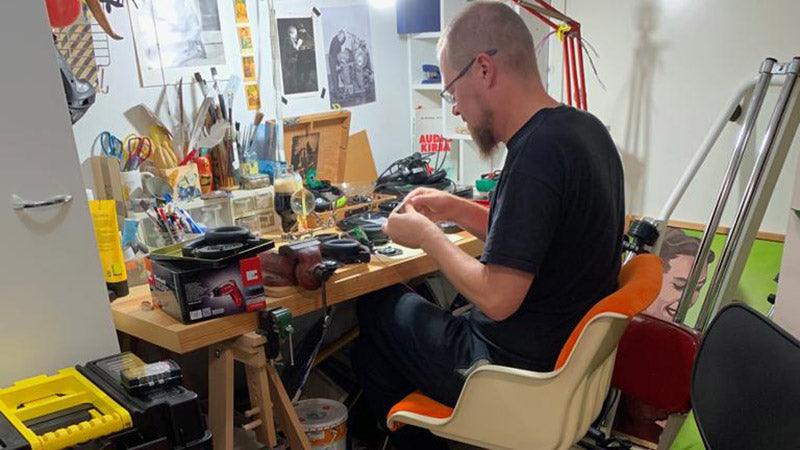
Up to this day, Valco’s cheerful lads have gone through an absurd number of factories and their prototypes, trimming and trimming again until only the very best ideas were left, and from that base we started developing this into a finished product with Finnish hands. And no, it’s not enough that some factory can deliver good components to us once. We also need to know they can keep doing it and that the quality and specs stay consistent. Every batch has to be just as good. The world is drowning in mediocre disposable crap, and we don’t want to be part of that.
I handled the stress testing by giving a pile of prototypes, without protective cases, to audio industry professionals, a.k.a. roadies, and telling them to handle them on work trips without any special care whatsoever. Only one pair of these broke. I can’t go into details, but the incident involved, among other things, a truck, stage structures, and high voltage.
Roadies are extremely creative when it comes to breaking things. Almost as creative as they are when it comes to fixing them.
Right then. So the sound is sorted and these survive a medium-sized nuclear war. What else matters in headphones? Ergonomics and usability.
Competitors have all sorts of fancy gimmicks and programmability in their cans, but the fact is that people want headphones that turn on with a button and sit comfortably on their head. All kinds of touch controls and magical gestures may feel very impressive in the store and in YouTube videos, but try using them when you’re sweaty on a run, or wearing mittens, with your face freezing off in winter.
One set of prototypes started controlling computer programs without being asked. They didn’t even burn that well in the midsummer bonfire. My motto is: ”Keep it simple, stupid!”
So these have one button that turns them on, connects them to the network and shuts them down. Another button for noise cancelling, plus volume control. And yes, you can use them in winter while wearing gloves.
In terms of looks, these are very much Chinese. That is purely down to money and priorities. Making plastic molds costs tens of thousands of euros, and doing our own design would easily have burned a hundred grand just to get production started. Because of that, we settled for visually modding a Chinese design that already worked perfectly well. Of course, we picked the best one.
We wanted something distinctly Finnish in the headphones, so they’ll have wooden end caps made by hand in Finland with the Valco logo on them. This is what you’d call “everyday luxury”
Instead, we decided to put the money into the guts of the thing, like battery life that lasts for days, even a week. And the latest and best Qualcomm Bluetooth chip, at least in terms of bang for buck. This, too, was tuned from our own real-life needs. When you switch on the noise cancelling and put on an audiobook, you need to be able to vacuum a whole two-story apartment even if the phone is in the hallway. Yes. There’s also a handsfree function, so personal calls to “Marjatta” are possible too, if the situation demands it.
The latency has also been polished down to something so negligible that sync holds up in movies and even in gaming.
So why weren’t these made entirely in Finland? There’s certainly enough know-how and skill here. Yes, there is, but product development from scratch takes time and is surprisingly expensive. Let’s put it this way: there is definitely rustling in the reeds, and our long-term vision is to make fully Finnish headphones from start to finish, once we’ve at least started somewhere first.
Oh, and did I mention that these headphones also have an excellently badass noise cancelling function.
We didn’t want to make some kind of sensory deprivation capsules that isolate you from the outside world. One of the curses of modern life is that people wander around in traffic with noise cancelling cans on and then, acting like everything’s perfectly normal, get hit by a train because they weren’t aware of their surroundings.
The real point of noise cancelling is not to isolate the user from the environment, but to knock down the constant hum, hiss and rumble everywhere to a level where it’s simply nicer to exist, and where you don’t have to crank the music so loud that it covers the noise around you.
These contraptions of ours are tuned so that the general background hum drops off significantly and, as a result, people feel better. But you can still keep track of your surroundings while wearing them, so you don’t, for example, die. Noise cancelling headphones are especially good when traveling, whether the vehicle is an airplane or an 80s diesel Mercedes.
We also paid attention to the fact that badly designed noise cancelling can make people feel dizzy and nauseous. Without going too far into the technical details, I can proudly say that the noise cancelling on these was not designed badly.
You can’t really understand how much a well-made noise cancelling function improves quality of life until you try it.
As our headphone project moves forward, we’ll keep sending more information your way, but while you wait, it’s worth signing up to Valco’s mailing list here.

Share with friends
Valco's Great Headphone Odyssey 2019!
VALCO noise cancelling headphones - an amateur review